IRS EIN Verification Change and the CP2100 Connection
The IRS has announced an enhancement to online Business Tax Accounts that allows businesses with such an account to download an EIN verification letter. The IRS says this letter can be used in place of Letter 147C.
But can it be used in a B-Notice setting? I am not so sure about that.
Readers may be asking, “what is this guy talking about, throwing out all these terms like we all know what he means? How dare he?” Let’s break it down.
Background — Why Do We Care?
Before explaining more about what has changed with EIN verification, we need to explain CP2100 letters and B Notices.
When you file a 1099 with the IRS, it will have your vendor’s name and TIN on it. If the name/TIN combination doesn’t match the IRS’s system, the IRS sends you a letter called a CP2100 Letter.
B Notices
When you receive such a letter, you must send your vendor a “B Notice.” The B Notice requests corrected information from the vendor.
In the B Notice process, there are two types of letters — a first B Notice and a second B Notice. That’s all we’ll say for today.
With second B Notices, your vendor must send back proof of their TIN. If it’s an SSN, this would be a Social Security card. If it’s an EIN, it would be a Letter 147C.
Letter 147C is problematic in this situation because the vendor needs to contact the IRS in writing (and include a copy of the second B Notice). The vendor can either fax a request or mail the request. When the IRS responds, they will send the Letter 147C by snail-mail.
Depending on when you sent the B Notice, this could put a squeeze on the timelines. If your vendor hasn’t provided the 147C to you within the proper timeframe, and you pay them again, you’ll need to do backup withholding on that payment — even if they have requested the 147C letter and are waiting on it.
Note also that the procedure here requires a 147C letter — not a copy of a tax return or some other document which might show the EIN. And that brings us to the discussion at hand.
Does the New Option Apply to B Notices?
The latest from the IRS is that they have upgraded online business accounts to add the ability of an authorized representative of a business to download an EIN verification letter from their online account.
In Issue 2026-24 of IRS e-News for Small Businesses (link here), the IRS says,
“An EIN verification letter or CP 575 is a digital notice that can be taken to a bank or financial institution for verification purposes.
This notice can be used instead of the letter 147c EIN Previously Assigned or the original CP 575 A-J.”
(Author note: this from the IRS is a direct quote, including the odd “letter 147c” part — everywhere else in IRS materials, it is shown as Letter 147C, with “Letter” capitalized, and the “C” capitalized. Whoever wrote this announcement didn’t capitalize either one.)
Anyway, back to the show. The IRS announcement says this can be used “instead of” Letter 147C. This is a problem in the B-Notice world, because everything, including Revenue Procedures, explicitly says Letter 147C only.
Publication 1281 (not authoritative, yet written as the source of authority) has always said that it must be a Letter 147C. Note what the language of the second B Notice says:
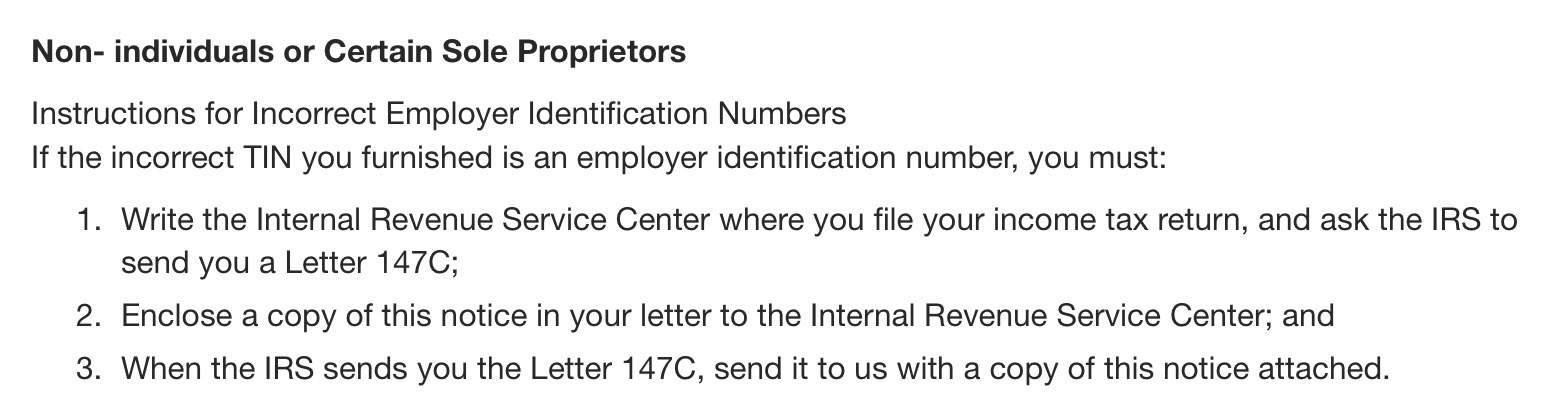
And in its directions to the payer (you): “You need a TIN validation (IRS Letter 147C or a copy of a Social Security card as appropriate) in order to stop current backup withholding or prevent backup withholding from starting.”
I feel like the “147C” part is key here.
The EIN validation you can download in your online account is simply a CP575. First, let’s see what this online verification document looks like.
I have a corporation, so I logged into my account to see what I could find. Here is the first step:
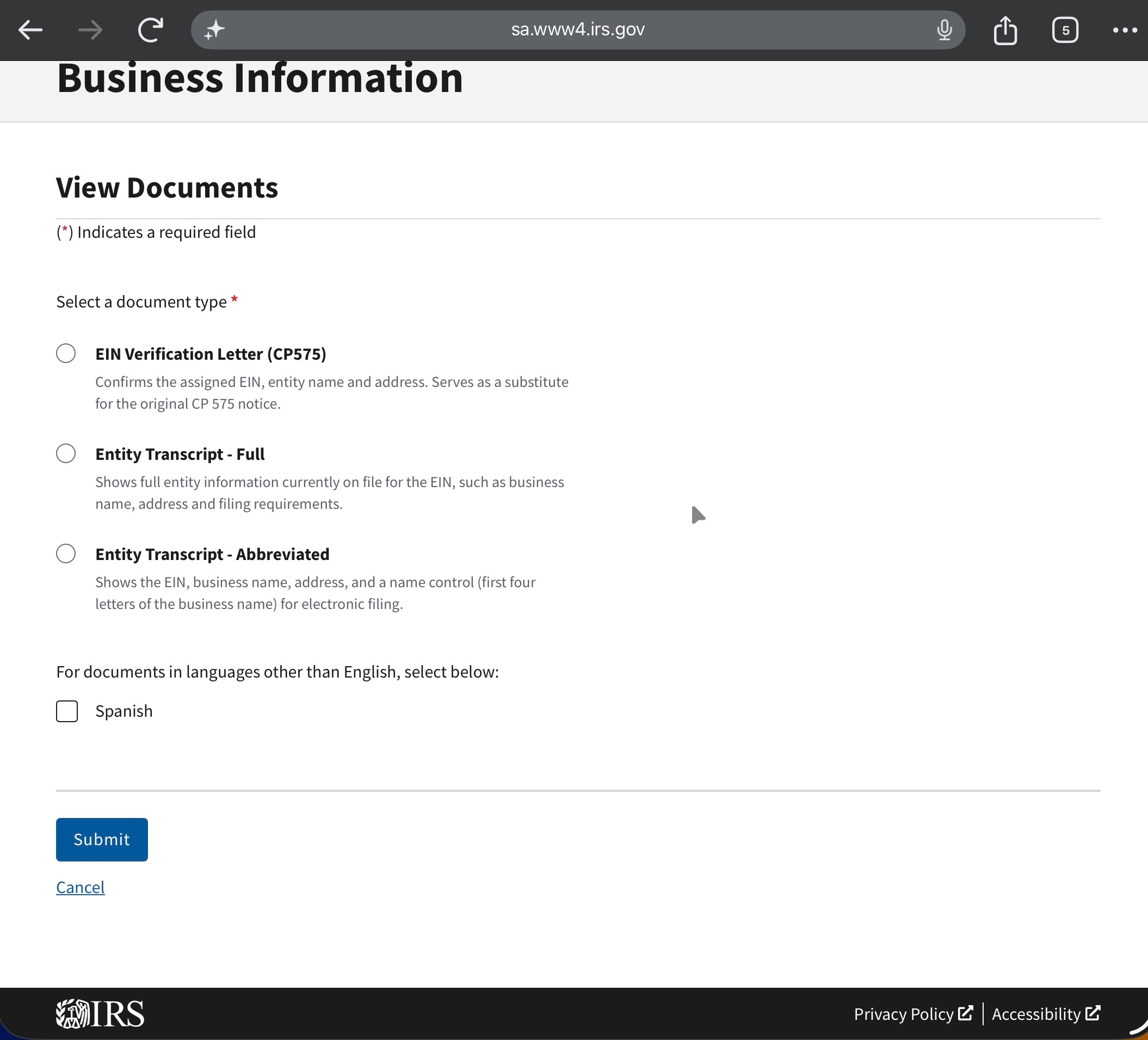
Oh hey, it says CP575, not Letter 147C.
And let’s see the document you get when you click on that.
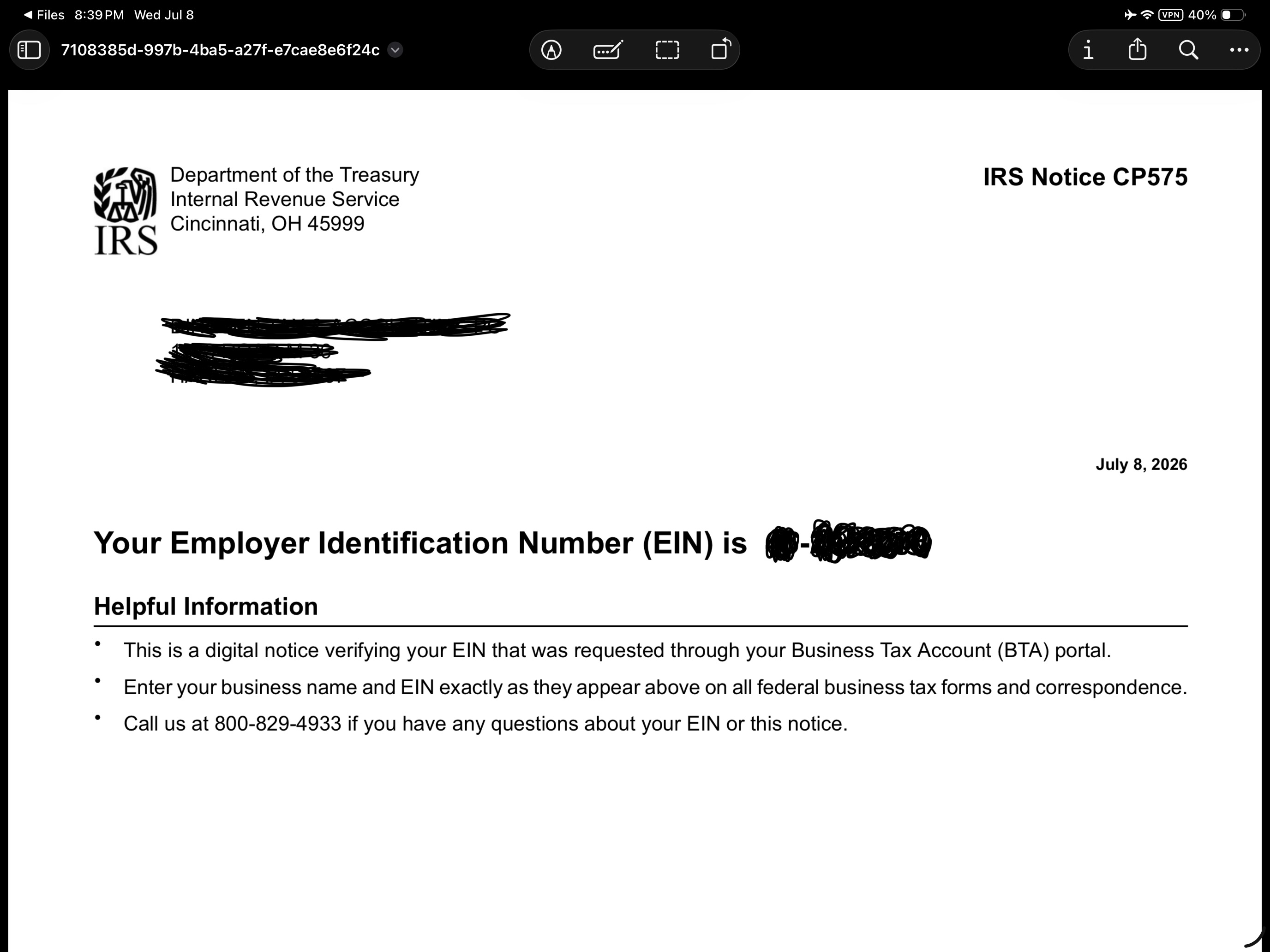
snail mail
It’s a Notice CP575, not a 147C.
Can You Use in B Notice Situations?
The problem here is, the B Notice language says 147C. The online EIN verification says CP575.
The regulations at 31.3406(d)-5(g)(5) don’t saspecifyy a specific type of document. It just says “Notification from the Social Security Administration (or the Internal Revenue Service) validating a name/TIN combination satisfies the requirements… only if it complies with such procedural requirements as the Internal Revenue Service provides in the Internal Revenue Bulletin…”
There are few references to 147C in anything formal, but the few times it is referenced, it makes it pretty clear you cannot rely on anything other than a true 147C document.
For example, Cumulative Bulletin Notice 91-40 lays out certain new dictates (“new” at the time) relating to second B Notice situations. There was a period between September 15, 1991, and September 1, 1992, when payers could accept proof other than a 147C. Then, the IRS says: “After this period, only … Letter 147C will be acceptable.”
Revenue Procedure 93-37 tells us:
“In the case of an incorrect employer identification number (EIN), a notification validating a name/TIN combination is effective for purposes of section 311.3405(d)-5(g)(5) of the regulations if it is made on IRS Letter 147C.”
Revenue Procedure 93-37 was modified by Revenue Procedure 2014-43, but this only changed pieces relating to Social Security numbers. It was silent on EINs.
In addition, the Internal Revenue Manual, in 5.19.3, specifies Letter 147C four different times.
Conclusion
There are two things your author thinks are true at this point:
- As a payer sending B Notices, it is his opinion that you cannot rely on this downloaded CP575. Everything published from the IRS clearly says 147C and only 147C. While the IRS does say, in the July 2 news release, that this downloaded CP575C can be used in place of a 147C, it’s clear that whoever wrote the press release was referring to things such as banking, not to B Notice situations.
- The IRS only sends CP2100 letters twice a year (spring and fall). The fall wave won’t come until mid-September at the earliest. This means we have time for the IRS to update the guidance.
The best course of action at this point is to watch and wait.
Wrapup
As usual, there are few easy answers with such a seemingly simple thing. How hard can a 1099 be, anyway? Well, considering that this article is over 1,000 words long, quite clearly it can be quite difficult!

Jason Dinesen, EA, is a distinguished tax professional and educator with a fervent passion for demystifying complex tax concepts. Jason prepares some tax returns each year, but spends most of his professional time teaching on various tax-related topics -- with 1099s being the one everyone comes back to over and over.
He's also the founder of Dinesen Media Ventures, which provides a diverse range of media content, ranging from continuing education programs for accountants and tax professionals to podcast production to radio and journalism content.
Recognized for his sharp tax interpretations, Jason is renowned for promptly analyzing the latest tax updates and IRS guidance, sharing his insights with the professional community. Over his career, he has educated more than 200,000 accounting, tax, and HR professionals on various topics.
Form 1099 was the very first thing he ever taught on, on April 26th, 2012, at a Sheraton Hotel next to a Lowe's in West Des Moines, Iowa.
